
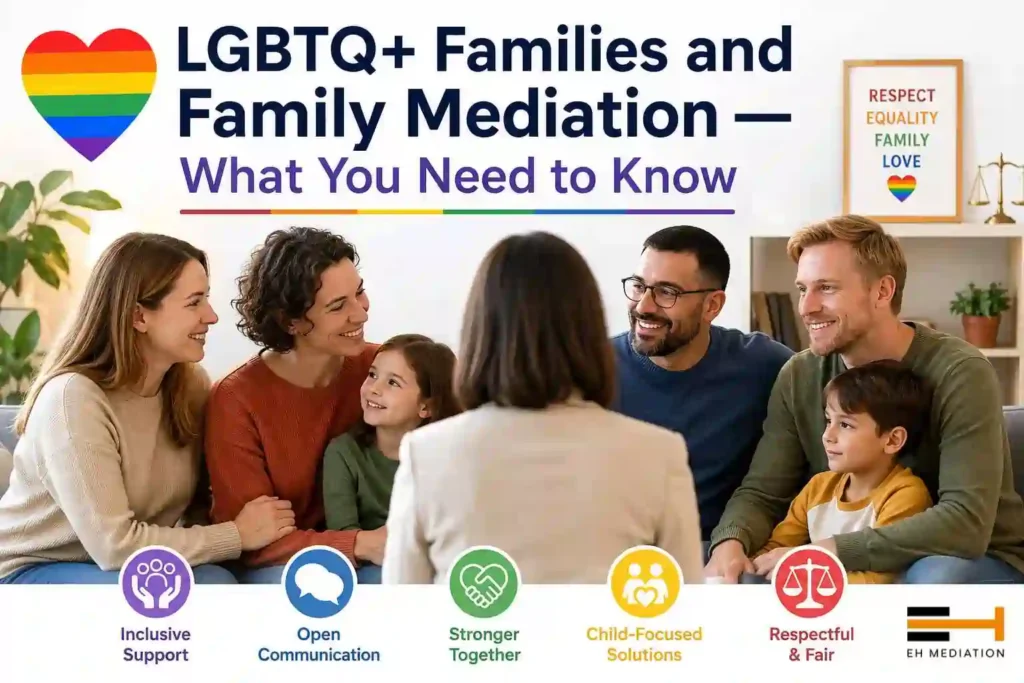
When relationships break down, things can become emotional very quickly.
There may be arguments about children, money, the family home, or simply frustration from months of poor communication. For LGBTQ+ couples and families Bath, there can sometimes be extra worries too — like feeling judged, misunderstood, or unsure whether the process will properly recognise your family dynamic.
That’s one reason many people look into family mediation.
EH Mediation Bath gives families a chance to sit down with a neutral professional and try to work through issues in a calmer, more structured way. It’s not about deciding who “wins.” It’s about helping people move forward with less conflict, especially when children are involved.
Most LGBTQ+ families Bath are relieved to have conversations — all of them — in an environment where they feel they’re being heard.
Understanding Family Mediation for LGBTQ+ Families
Family mediation is designed to help people resolve family-related disagreements without immediately going through stressful court proceedings.
A trained mediator helps guide the conversation, keeps discussions productive, and encourages both people to focus on practical solutions rather than blame. Check this also: Family Mediation for Muslim Couples — Talaq, Islamic Divorce and UK Law
A lot of couples come to mediation because communication at home has completely broken down.
Some people say:
- “Every discussion becomes a debate.”
- “We never agree on anything concerning the kids!”
- “We have no idea what is market fair.”
- “Things are becoming too stressful.”
Some, meanwhile, just want a way to separate without deepening the animus.
If mediation is provided for same-sex couples who are part of the LGBTQ+ community Bath, it might involve:
- Parenting arrangements
- Separation or divorce discussions
- Financial disagreements
- Co-parenting after separation
- Property disputes
- Communication issues
- Related to identity or acceptance, family tensions.
No two families are the same, which is why mediation is often more flexible than people expect.
Common Family Issues LGBTQ+ Couples and Parents Face
Most separating couples experience stress, uncertainty, and emotional tension. But LGBTQ+ families Bath can sometimes face additional complications that make situations feel even more overwhelming.
1. Parenting Disagreements
Children are often the centre of the biggest disagreements after separation.
Parents may struggle to agree on:
- Where children will live
- School routines
- Holidays and birthdays
- New partners are being introduced.
- Day-to-day parenting decisions
Sometimes the issue isn’t the disagreement itself — it’s the communication around it.
One parent may feel shut out. Another may feel they’re carrying most of the responsibility alone. Over time, resentment builds.
Mediation gives both people the chance to explain their concerns properly without constant interruptions or arguments.
2. Financial Pressure
Money worries create huge stress during separation.
That is, the mediation is when the people come asking a few things like:
- “Who keeps the house?”
- “Why is that so damned hard?
- “What happens to shared savings?”
- “What if we simply had one of us up the contribution across the board?”
- “How do we make money with children?”
Financial scenarios can legally be more perplexing for partners in an unmarried relationship.
3. Feeling Misunderstood
Some LGBTQ+ individuals worry they’ll have to explain or defend their family situation during legal or mediation processes.
That anxiety is real for many people.
Trans and non-binary individuals may worry about being misgendered. Same-sex parents may worry their parenting role won’t be taken seriously. Others simply want to avoid uncomfortable or insensitive conversations during an already difficult time.
A good mediator will be inclusive, that is, aware that all family structures require the same degree of respect.
Is Family Mediation Inclusive for LGBTQ+ Individuals?
Good mediation should feel safe, respectful, and balanced for everyone involved.
That means:
- Referred to by their correct name and pronouns
- Respecting different family structures
- Avoiding assumptions
- Or saying that both people should talk for the exact same amount of time.
- Keeping discussions neutral and professional
Anxiety is also apparent with LGBTQ+ clients Bath, often with a fear of not being heard correctly.
That’s why choosing the right mediator matters.
A supportive mediator won’t make your relationship or family dynamic feel “different” or unusual. The focus stays on resolving issues constructively and helping everyone communicate more clearly. Financial & Property Mediation: A Practical Guide to Fair Divorce Settlements
Feeling comfortable enough to speak honestly can make a huge difference during mediation.

LGBTQ+ Parenting and Child Arrangement Mediation
When children are involved, emotions are usually even higher.
The majority of parents really want the best for their children, but as former partners, agreeing on what that looks like is not easy.
Some common concerns include:
- Keeping routines stable
- Managing shared parenting schedules
- Disagreeing without Disruption around Children
- Helping children adjust emotionally
- Determining the way forward for making major decisions
LGBTQ+ parenting Bath situations can sometimes involve additional layers, too including:
- Adoption arrangements
- Donor conception
- Co-parenting agreements
- Step-parent involvement
- Blended family dynamics
Mediation is there to relieve some of the acrimony and create practical arrangements for children that are built to endure.
Children often cope better when parents are able to communicate more calmly and consistently after separation.
Separation and Divorce in LGBTQ+ Relationships
Ending a relationship is emotionally exhausting, no matter who you are.
Some couples separate relatively amicably. Others arrive at mediation after months — or even years — of arguments, frustration, or emotional distance. Managing Divorce: How Family Mediation Supports Children’s Well-being
People often feel:
- Hurt
- Angry
- Anxious
- Confused
- Overwhelmed
- Worried about the future
They may also have anxiety about housing, finances or parental arrangements.
For LGBTQ+ individuals Bath, separation may trigger extra emotional stresses related to family acceptance or rejection, community support or the lack thereof, and even identity-related distress.
Mediation can help slow things down.
Instead of every conversation turning into a conflict, people have a space where discussions are guided more calmly.
That doesn’t mean mediation is always easy. Difficult conversations still happen. But many people find it less intimidating and less emotionally draining than court.
Financial and Property Disputes in LGBTQ+ Families
Financial disagreements are one of the biggest reasons couples seek mediation.
Sometimes one person feels they contributed more financially. Sometimes, both people are worried about stability after separation. Other times, neither person knows what’s fair anymore because emotions are getting in the way.
Common issues include:
- Shared homes
- Rent or mortgage responsibilities
- Savings
- Debts
- Child-related costs
- Joint purchases
- Financial support after separation
It can be stressful and uncertain especially for unmarried couples to sort out finances.
Mediation allows people to talk through these issues step by step instead of making rushed decisions during arguments.
Many families simply want clarity, fairness, and a way to move forward without constant conflict.
Benefits of Family Mediation for LGBTQ+ Families
One reason mediation appeals to many families is because it tends to feel more personal and less confrontational than formal court proceedings.
- It Facilitates Communication: A mediator is an intermediary; they help you stay on topic even when discussions and emotions are running high.
- It can Complicate Your Stress: the court compounds the stress on your decision-making in your marriage. Mediation is typically less formal and more conversational.
- It Helps Keep the Focus on Children: Instead of revisiting relationship problems repeatedly, discussions are guided towards practical solutions for the future.
- Decision Making: It gives families more control, couples enter into agreements rather than having decisions forced upon them.
- More Confidential: Mediation, by nature, is often a preferred option for many individuals because the conversations that unfold there are more private.
- It Saves Time and Money: Mediation normally takes less time and costs less than a long trial.

When Family Mediation May Not Be Suitable
Mediation is not right for every situation.
If there has been:
- Domestic abuse
- Coercive control
- Intimidation
- Fear for personal safety
- Serious manipulation
- Ongoing threats
Then mediation may not be appropriate.
A professional mediator will normally assess whether the process feels safe and balanced before mediation begins.
In some cases, however, it may be necessary to seek legal advice or take the matter to court.
FAQs
Q: What if communication between my ex-partner and me completely breaks down while going through LGBTQ family mediation?
One mediator helps keep conversations calm and on track, so both parties can share their ideas without fights breaking out. If you feel that communicating directly with someone is too challenging, they may also offer shuttle mediation.
Q: How can LGBTQ+ parents resolve disagreements about child arrangements without going to court?
Mediation is used to help parents have conversations in a less combative, more child-focused manner about living arrangements, routines and holidays, as well as parental duties.
Q: What happens if one partner feels financially vulnerable or worried about fairness after separation?
It allows both parties to have a conversation about their finances, and reach reasonable prices for ownership items, expenses, savings and contributions, moving further on.
Q: Can transgender and non-binary individuals feel safe and respected during family mediation?
It is essential for a professional mediator to ensure that all identities are reflected and honoured with respect throughout the process, including names, pronouns, fathering/mothering language,, and family dynamics.
Q: What should I do if my child is struggling emotionally after an LGBTQ+ family separation Bath?
Mediation can help parents reduce conflict, improve communication, and create stable routines that may help children feel more secure during family changes.
Q: When is family mediation not suitable for LGBTQ+ couples or families Bath?
There are some types of cases where mediation would not work — like, for example, with domestic violence, threats or intimidation, coercive control of one spouse over the other, or safety issues.
Family problems rarely have simple solutions, especially when emotions are involved.
But for many LGBTQ+ families, EH Mediation provides something important during difficult times — a calmer space to talk, feel heard, and work towards practical solutions without unnecessary hostility.
Even when couples disagree, being able to communicate more respectfully can make a huge difference for everyone involved, especially children.
For Further Information Please Contact Us